Friday, 23 October 2015

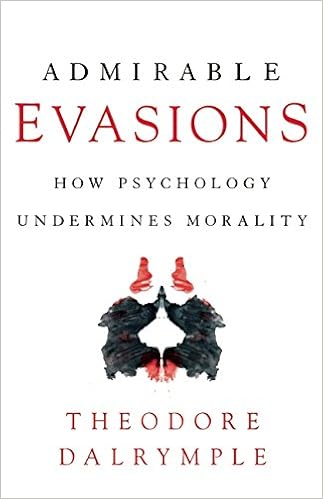
Admirable Evasions - Theodore Dalrymple

It has been some months now since I have blogged - not that I have stopped reading, although, that too has slowed with everything that is going on in life presently.  I am trying to set the reading record straight by a series of entries to catch me up.

It was a little bit of a thrill when I found that Dalrymple (Daniels) had published another book.  The man is nothing if not prolific.  I first came across him in 2005 when I read his book "Life at the Bottom", then the superlative "Our Culture: or what is left of it".  Finally, "Spoilt Rotten: The toxic cult of sentimentality", this is the seminal book on sentimentality and it's affect on Western Culture.    When you live holding a minority worldview, it is always exhilarating to read Dalrymple's work.  It washes you clean from the daily grind and refocuses you on thinking through issues rather than the sentimentalism of today's secular left.  Since then I have tried to follow his essays online.  There is a tremendously insightful essay on tattoos dated from the year 2000, it is even more prescient today than when written.

Daniels is a doctor, but has fostered a love of literature and philosophy since he was pressured into a medical career.  For many years he worked as a prison doctor, indeed a psychologist.  He is well travelled, well read, well though of and can he write!

Well, 'Admirable Evasions: How psychology undermines morality' is a fascinating book.  I jumped at the chance to read it and read it quickly.  I digested it in the week leading up to a seminar that I went on hosted by the 'Science of Learning' centre at Melbourne University.  This seminar was on Neuroscience, Cognitive Psychology and Education.  We currently have undergone a wholesale change in attitude at my workplace where 'Positive Psychology' and it's mystical corollary 'Mindfulness' have entered the sway and been uncritically and universally accepted as good things.  I have been somewhat skeptical about this change and have been glad that it has not directly affected me.  This is not being unduly critical of my workplace - this stuff has been accepted across Education nationwide.  This is the current fad!  Everyone is a part of it to greater or lesser extent.  Along with this, I was interested to read that the Neuroscientist present at the conference was a student of Stephen Pinker.  I assumed that he would be in Pinker's mould, an adamant Monist, physicalist and hostile to any form of dualism.  I signed up thinking that I may be an unwelcome agitator.

To my surprise, the opening salvo was a stern denouncement of the way Neuroscience has entered Education.  They openly mocked and decried the folly of the many programmes that are introduced into schools as the next best thing and how neuroscience adds credibility to Educative programmes that are not warranted.  Further, they stood by the statement that Neuroscience has nothing to offer Education.  The presenters were of the belief that Neuroscience can only inform Educators when filtered through the medium of cognitive psychology - a thesis in which they have since published, and one with which I concur.  Moreover, the Neuroscientist turned out to be a duelist and smiled when I looked at him astonished.  He said "Pinker is a lovely guy and has been so supportive of me, however, when he opens his mouth, I just can't bring myself to believe that stuff."  I was stunned.

Dalrymple's book prompted questions that I did't have to defend - they were largely agreed with.  His assault on Modern Psychology starts immediately:

"Psychology is not a key to self-understanding, but a cultural barrier to such understanding as we can achieve; but it is my belief that we shall never be able entirely to pluck out the heart of our mystery. Of this I am glad rather than sorry."

His distain for the effect upon society is clear:
"We owe incomparably more to improved sewers than to psychology."
He is invariably in tune with the Utopian nature of the influence of Neurology and psychology in our modern world and compares it with the enlightenment view of Liberal Democracy.

"Before long, if there is sufficient research funding, there will be no more puzzles and no unpleasant surprises, no agonizing dilemmas in human existence; the question of the good life will have been settled once and for all, indubitably and scientifically, without the necessity of endless and unprovable metaphysical speculations ... History will come to an end, this time not by virtue of the triumph of liberal democracy throughout the world, but by that of the triumph of psychology and neuroscience. Man will no longer pass on misery to Man, as in Larkin’s poem; he will pass on knowledge instead, knowledge and wisdom being of course by that stage coterminous. Indeed, knowledge will secrete wisdom as the liver secretes bile."
Dalrymple really resonates with me here - his declaration at this point is, "I don’t believe it, and I’m not sure that I would want to live in such a world if it were true." I wholeheartedly agree!

Dalrymple then proceeds to systematically undo Freud, Psychoanalysts, Behaviourism and the ultra-modern penchant for Neurology.
"That the latest neuroscience as a means of humanity understanding itself has been grossly oversold scarcely needs proof. It offers the illusion of understanding rather than understanding itself."
Self-understanding is best found in literature, Dalrymple argues - he says that psychology has not advanced human understanding beyond Shakespeare (the title of the book is taken from King Lear).

"...psychology has contributed nothing to human self-understanding; rather the reverse: for by coming between a man and what Doctor Johnson called “the motions of his own mind,” it acts as an obstacle to genuine (though often painful) self-examination."

As usual, Dalrymple is right.  However, our society will not heed the call, but plough on its shallow way of carving out the coming dystopia - where the search for Utopia always ends up.

5 Stars - I'd give it six if I could.  Must read.

Sunday, 7 June 2015

The intolerance of Tolerance - D A Carson

I have found this book refreshing and instructive.  I have suspected that its thesis is true for some time now, yet I never knew the philosophical underpinnings of the views discussed.  Carson does an excellent job in overview of these issues.  Let me explain:

The first chapter is entitled '"The changing face of Tolerance" and seeks to explain the difference between what Carson calls the 'old tolerance" and the "new tolerance".

Old tolerance was about tolerating people, you would disagree with their views loudly and vociferously, yet you protected there right to hold that view and bring it into discussion in the public square.   The new tolerance insists that you tolerate every view as equally valid.  If you do not display tolerance to other views - you, yourself are being intolerant and that, simply cannot be tolerated!  Intolerant people cannot be tolerated - herein lies the incoherence of modern expressions of tolerance or judgement.  Carson says that when one reads the title he may be struck that this is 'arrant nonsense' or 'an obscure oxymoron'.  However, tolerance currently occupies a very high place in Western society; indeed it is often seen as the primary ethic upon which all ethical constructs are built.

"The new tolerance suggests that actually accepting another's positioned means believing that position to be true, or at least as true as your own." (pg.3)
This is a significant change from the past and it is had a profound effect on on society. Carson begins to give empirical evidence of the effect of this is having a society by narrating many stories currently the news.

Carson deserves to be quoted at length on this issue.

"The rising number of Muslims in England has prompted subtle eviction of pigs and the stories. In some schools, the story of the three little pigs is now banned, as Muslim school children might be offended by stories about unclean animals … Calendars with pigs, porcelain porcine figurines, even pink shaped stress reliever's all had to go, including a tissue box depicting Winnie the Pooh and Piglet … When pressed on why pigs had to go ... a Mulim counsellor in West Midlands, explained, "its a tolerance of people's beliefs." Stunning doublespeak! What about the tolerance of those who think differently about pigs? In the name of tolerance towards the beliefs of Muslims, intolerance is imposed"(p.24)
And again:

"In 2008, the Supreme Court of California will get two physicians could not legally refuse artificial insemination to a woman because she's a lesbian. The doctors have not withheld the service because they disagreed with her: they argued but they happily provide medical care to all kinds of people with whom they disagree. They would not withhold cancer treatment from a rapist, for example. But where they felt they had to draw a line was in their own participation in an act that they judged to be immoral … In this decision, the courts stated, "Do the rights of religious freedom and free speech, as guaranteed in both the Federal and the Californian constitutions, exempt the medical clinic's physician from complying with the California Unruh Civil Rights Acts prohibition against discrimination based on a person's sexual orientation? Our answer is no." (p.39)

In a chapter called the "jottings on the history of tolerance" Carson elucidates how society has always discussed what we should be tolerant & intolerant of.  This has always been against the backdrop of right and wrong, objective right and objective wrong. Rather than being a property predicated upon other ethical values, tolerance is now paramount in its own right.  It has become the ontological bedrock of modern ethical systems.  

One of the important issues that arises in discussion of tolerance and societies tolerance, is the issue of church and state. Many Christians, indeed I am one of them, support strict distinctions between church and state. However, this is been transformed into something that was never meant to be; either the American Constitution, with the letters to the Danbury Baptists, or the Australian Constitution. Carson says, "We start by insisting that state can either establish your prohibit religion, and agree that, reciprocally, religion does not have the right to control the state. Then in a mighty bound many infer further that religion does not have the right to influence any of the decisions of the state, and therefore conclude that religion must be restricted to a small and privatised world or the great barrier between church and state is jeopardised." (p. 67, Italics mine)

 In discussion of the gains that the new tolerance has made, in contrast to its losses, Carson is quite poignant:
"In reality, the genuine gains achieved by the new tournaments are slender in comparison with the losses. It has been moderately successful at diminishing demeaning epithets - " wogs"," chinks," and expressions of saying order. Even there the price is a certain kind of totalitarian political correctness.  More serious, however, is the way the new tolerance swamps penetrating discussion about truth morality: tolerance is widely perceived to be more important and more enduring them either. The result is a greater tendency to believe lies and to come adrift in immorality… far from bringing peace, the new tolerances progressively becoming more intolerant, fostering moral myopia, proving unable to engage in serious and competent discussions about truth, letting personal and social evils fester, the remaining blind to the political and international perceptions of our tolerant cultural profile" (p. 138-9)

Following this there is an outstanding little chapter on politics and democracy, where Carson has some insightful things to say about democracy as a form of government and how democracy works best predicated upon a worldview that values truth.

Finally a list of ten things that Christian's should do in response to the new tolerance:

  1. Expose the new tolerances moral and epistemological bankruptcy
  2. Preserve a place for truth
  3. Expose the new tolerances condescending arrogance
  4. Insist that the new tolerance is not progress
  5. Distinguish between empirical diversity and the inherent goodness of all diversity
  6. Challenge secularism's ostensible neutrality and superiority
  7. Practice and encourage civility
  8. Evangelise
  9. Be prepared to suffer
  10. Delight in and trust God
Insightful book & I couldn't agree more with Carson's list.  The only way that I can ensure that my views are heard - is if all views can be heard.  Limits on free speech are largely unwelcome in a liberal society and I worry about those that seek to curtail them.

5 Stars


All the way home (South Sudanese parent's stories for their children in Australia) - A Malual, A Maluk et al

It is so rare to find a book that will make me cry.  This is perhaps the most beautiful thing that I have read in recent times.  It is a truly moving book - I know some of the people in the book and, as such, I thought that I would find it interesting; however, I did not know what I was in for.

There is a story (as always) behind my reading of this book.  I was reading the local paper a week or so ago and I saw a picture of a young girl in my class holding a book up with her Dad.  This particular South Sudanese girl has the most beautiful smile, however, can be very quiet and reclusive.  Brazenly I said in class, in front of everyone, 'Did I see you in the paper holding a book that you had written?"  She was embarrassed and found me confrontational and the situation awkward.  I don't usually care about those things and powered on with my questioning anyway.  She eventually agreed that there was a book about the Sudanese community but it could have been her sister in the paper.  I said that I was interested in reading the book; I like to support the kids in your class.

Well, there are two other Sudanese students in the class, a quiet boy who was listening to the interaction but was silent the whole time.  The next class that we had - he approached me and passed on a copy of the latest book that the local South Sudanese community has produced.  I read it that night.  I simply couldn't put it down.

The book is an insight into South Sudanese culture and personal stories of refugees who have come into my local community.  It is more than that though.  It is the sharing of the stories and culture to their children.  It is an attempt to communicate with kids that want to be Australian and fit into Australian society.  It's a personal invitation to sit at their family dinner table and listen to these people communicate with their kids.  It is intensely personal - yet never voyeuristic.  You feel so special to read these personal accounts - so heartbroken at the trials faced by these people, and for me so jealous that they have such a strong culture.  Ours is broken and we seem hellbent on breaking it further - theirs is so strong.

In the introduction Abraham Malual shares how they want to assimilate into this country, however, not reject their own culture and stories.  This is the sort of bicultural substructure that Noel Pearson advocates, but seems so unwilling to be embraced among Indigenous peoples.  I, for one am glad that these people bring strong families into Australia - it is my hope that they will help us reclaim what we have lost.

The book is a set of stories about life in South Sudan or the difficulties of life in Australia.  Initiation, facial scars, menstruation, marriage dowry's, death of loved ones and problems with English teaching in Australia, it is all here.  Every story has a brief response from one of their children.  Some of them are priceless.  You'll laugh, cry, wince, laugh again and, if you are like me, feel jealous that such wonderful stories can be shared in families.

Storytelling simply doesn't get better than this - it will make these lovely people even more endearing to you.  Absolute must read.  I'm going to get them all.

5 -stars

Saturday, 16 May 2015

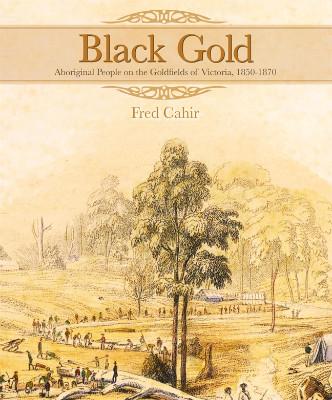
Black Gold - Fred Cahir

It is an interesting story how I came to read this book.  It all started with the Clare Wright Eureka book that I reviewed here.

I was fascinated by an incidental phrase in Wrights book and so I contacted her to clarify.  Here is our email exchange:

Hi Ms Wright,

I am writing because I have recently finished reading your book "The forgotten rebels of Eureka"; I am a history teacher teaching Year Nine history in country Victoria.

I read your book primarily because I didn't know a lot about mining history in Australia, and I had to teach the Eureka Stockade as part of the national curriculum, and I wanted to bone-up on recent scholarship.  I'd not taught history in a number of years...I have found your book a fascinating read, is exquisitely well written and indeed a rollicking tale. Your book has piqued my interest and, as such, I have a question in which I hope that you can point me in the right direction.

On Page 136, you state this:

"The only miners and traders on the goldfields you do appear to have been genuinely exempt from license holding were the Wathaurung."

You have a section a little further on in the chapter that states how both aboriginal men & women were gold-mining. Also, in the chapter 'winners and losers' you expand upon the perceptions in which the aboriginal people were held.

My questions are simple ones; why were the local aboriginal clans with exempt from license holding?  Has comparable research to yours, been done in regards to aboriginal involvement in the Stockade? If so, can you recommend some reading.

Thanking you,

Matt Harris

Hi Matt,

Thanks for your email and your generous feedback.  I'm glad you enjoyed my book.

Re your interesting query: my sense is that because indigenous people were not counted as people (e.g.: not included in the census or regarded in any way as citizens) they were de facto exempt from licensing holding.  They did not technically exist.  Although there are accounts of Wathaurung people engaged in mining, I have not come across evidence of them taking out a licence or being fined for not holding one.

The expert in this field is Dr Fred Cahir who teaches at Federation University in Ballarat.  His book Black Gold: Aboriginal People on the Goldfields of Victoria, 1850-1870 is worth a look.

As you are a teacher, I should also let you know that I have a Young Adult version of my book coming out in August.  It is aimed at a secondary school audience, mindful of the national curriculum.

Thanks again for your enthusiasm.

Clare

So that is how I came to read Fred Cahir's "Black Gold".  It is available free to read as an electronic download here.

This book is fascinating too - the background in mining that the Indigenous Australians have is fascinating.  Chair states that "...much evidence shows Aboriginal people quarrying for crystal, greenstone, sandstone, obsidian, kaolin, ochres and basalt across Victoria."  But what about that heavy yellow metal that gripped the interest of so many people, from so many places?  Did Aboriginal people seek that?  Cahir interestingly states that "[t]here are instances of gold nuggets being found associated with old Aboriginal sites, well away from auriferous reefs. The Watchem Nugget from near Maryborough (1904) and the Bunyip nugget from near Bridgewater, east of Bendigo, may both have been carried to their recorded place of discovery by Djadjawurrung people."
  

Cahir has an interesting section on Indigenous and Chinese relations, this section was particularly interesting:

"The reverend Arthur Polehampton, who spent much time in the Western district of Victoria in the 1850s, considered that ‘The blacks are said to have a strong prejudice against the Chinese, whom they accuse of being neither black nor white’, and a Ballarat Star correspondent reported in 1862 on an ‘exchange of insults’ between an Aboriginal and a Chinese man in Avoca. Similarly, Peter, a Djabwurrung man, was imprisoned for a week in December 1866 at Ararat for ‘assaulting a Chinaman whilst drunk’." 

There is a wonderful section under the chapter heading of Co-habitation, in which Cahir exemplifies Indigenous cultures focus on kinship and the resuscitated kin relationship.  This is a syncretic belief from Indigenous pre-colonial times and Christianity.  This explains some of the willingness to help with gold location, even without rewards.  Cahir then goes on to explain the extent of the environmental damage that alluvial mining left in its aftermath and how this indigenous peoples dislocated.  I must confess that there is some very fair and balanced writing about Government and the Missions.  Chair is so evenhanded here and, particularly shares some interesting insights into the missions and the role of Aboriginal Christians.  Much to the churches chagrin some did not view the Aboriginals worthy of delivering the message too.

"... there was a degree of discord in Christian circles about the fate of Aboriginal people. Some pronounced that ‘Australian aborigines were mere beasts in human shape ... and that no efforts made to evangelise the aborigines of Victoria could be successful’." 

Others viewed it very differently:

"Other prominent Christians considered that ‘the condition of the aborigines is that of dying men’ and as all men are created in God’s own image, they could be ‘saved [from extinction and damnation] only by divine interference’."

Some Aboriginal Christians held radical beliefs about the importance and the truth of Christianity:

"Missionaries, including Daniel, an Aboriginal man from the Lake Hindmarsh region, firmly believed they were acting in the best interests of Aboriginal people, and that to be ‘raised’ in Christianity was compensation for their losses as a result of British colonisation." 

Really fascinating book, in quite an unexpected way.  I think that it is an important read.  Cahir states that one of the reasons for writing the book was to encourage others to look at the shared history that white and black Australians have in regards to mining and forge a common history in view of reconciliation.  My specific question to Clare Wright was never answered - however, it has been an interesting tangent to stroll down.
4 Stars


Wednesday, 13 May 2015

Rosencrantz and Guildenstern are Dead - Stoppard

I've been a little bit busy of late and have not had time to write on the blog - however, I have tried to keep up with my reading.  This too, is hard when the work gets a little on top of you.  I've been away on two back-to-back camps and it was tiring.  However, I have been reading little by little none-the-less.

A box of books that my school library were getting rid of appeared mysteriously in the staffroom a few weeks ago.  Take what you want was the requirement and rummaging through the box I stumbled upon a copy of Stoppard's brilliant play.

I remember seeing the 1990 movie with Gary Oldman and Tim Roth in the early 1990's - the Blackburn Video shop had a VHS copy.  I think that I was the only one who ever hired it.  In those days I was a young Music student at an Arts University in Melbourne.  I'd just discovered Beckett and I had been introduced to Phillip Glass and Salvador Dali. I had a big Dali on the wall of my room and booked tickets in 1993 to see 'Einstein on the beach' when the first world tour arrived in Melbourne.  I listened for many hours to John Cage's beautiful Prepared Piano Sonata's as I discovered Minimalism, Surrealism and other forms of post-modernity in the arts.  So Stoppard's play appealed to me.

Re-reading this play, some twenty-two years later was interesting.  I was able to put things in better perspective, now that I have read Francis Schaeffer and particularly Hans Rookamakker.  My study into the worldview concept that began in 2005 - ten years ago - reading James Sire's 'Naming the Elephant' has put me in better stead to understand the place of this form of Art and view it, understand it from my perspective rather than a worldview forced upon me - as it was when I was younger.

The magnificent writing and fantastic humour of Stoppard's play strike you clearly at the beginning of the work.  It is a marvellous dialogue between out two protagonists (maybe victims, maybe solipsists)  as they discuss probability, socialism, existence and knowledge.  It is a scream to read and too many lines that could be quoted.

I stopped in Act 2 to read (selectively) Hamlet again.  Having the luxury to do that - which you don't in a theatre or watching the movie - made the read better and creates a burgeoning respect for Stoppard's play.

Lots of themes in this play are mentioned, issues of ontology, epistemology, logic and insignificance and many of these themes I mention in reading other works.  In this one - I just think that it is funny and clever.

5 Stars - Brilliant.

Monday, 30 March 2015

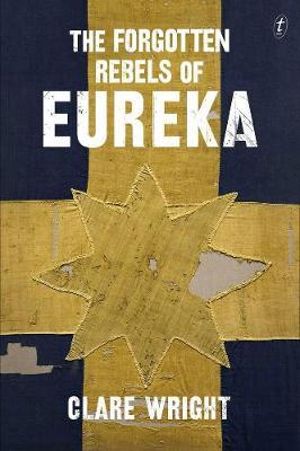
The Forgotten Rebels of Eureka - Clare Wright

 
Of all the events of Australian history I know least about - Eureka is the top of that list.  Perhaps that is bad, perhaps I am negligent, and perhaps that is reflected in my personal dislike of Unionism.  I don't know.  It does seems somewhat unpatriotic though, it does seem too churlish to not know anything (or at least remembered anything from school) about Eureka, the stockade, the killing of the miner Scobie and the burning of the Hotel owned by the Bentley's.  I feel even more ashamed as Wright articulates that this is “…what all school children know.”  I don't.  Things get worse as I have to teach a unit of Eureka in my Yr. 9 History class in but a few weeks time.  Arggghh.
Wright quotes Blainey:

"Eureka is like a great neon sign with messages that flick on and off with different messages for different people on different occasions." (p xii)

Wright is seeking to use Eureka to "...illuminate issues of gender bias in our collective bedtime stories."  This sort of lefty proposal doesn’t sit well with me.  I was even more concerned when I read the endorsement in the inside cover from the Marxist left review:
“It is exhilarating to encounter a historian who thinks that writing women into history in not about emphasising family life, or portraying women as victims of men, separate from the big struggles for democracy and justice.”
Whoa, what about that then!  As I embarked, I wondered if the Marxist left and I were reading the same book.  Other reviews were closer to fact – the Courier Mail was one:
 “Beautifully written, her book takes readers on a vivid journey of what life was like for the families of the miners, merchants, prostitutes and police … It’s a great story.”

Wright's book is a gambolling ride through the 1850's in Victoria.  Wright is an outstanding story-teller and a truly wonderful writer.  Let me share two wonderful sentences, lightly peppered with alliteration and imagery. 

"But it was not just ideology that wove women into the fabric of the goldfields society.  In the hard-nosed way of British bureaucracy, there were structural provisions made for the reality that woman would be integral to the colonial economy." pg. 135. 


Wright shares that one major difference in the Californian Gold rush and the Victoria one was the abundance of Women on the Goldfields.  This was an ideological ploy, as it was believed that women were a civilising element and that the Australian Goldfields would not degenerate into the lawless frontier that was in the America's.  However, let's look at the writing.

I've marked the alliteration in the text; wove women, British bureaucracy, women would and the pièce de résistance, colonial economy.  Economy, having an iambic foot, sounds like alliteration (actually assonance) because of the unstressed ‘e’ and the stressed ‘c’.  Wright’s writing is sometimes so poetic.  She really is a wonderful writer and I think that I’ll be reading more of her as a result.  Then, of course, there is the fact that the imagery of weaving – working with fabric – is the metaphor used in the first sentence. Finally, there is the lovely way that this sentence is beefed up, injected with testosterone, by beginning with a preposition. It is just marvellous.
The stories are truly wonderful, the tales of immigration and the stories of Sarah Hanmer and Clara Du Val are fascinating, even more so as they develop throughout the book.  The stories of travel sickness and death in unsanitary conditions of the ships, along with the celebrations of crossing the equator line were riveting. The walk to Ballarat, particularly the asides, like how Wright mentions 'The Gap' at Bacchus Marsh.  A place where the dray's got stuck crossing the ravine and had to be pulled out.  They waited for days for this to happen and a good deal of money was made by those who did the pulling out.  This is contrasted with the "nifty rollercoaster stretch" of the Western Highway that we travel today.  It made me scurry along to Google Map to try to locate it.  Of course, the Stockade itself too.
The Scholarship is outstanding and the conclusions drawn do not seem forced.  Janet Kincaid's rather nasty letter to her husband is an interesting find.  Sarah Hanmer and Clara Du Val's lies about themselves demonstrate the desire to make new identities for a New World.  Culminating in the most provocative thesis of the book.  At the end of the chapter 'Parting with my sex' Wright illustrates how Ballarat in 1854 was a functioning township, not a miner's slum or frontier outpost.  She states that Gov. Hotham believed in the inveterate ability of women to humanise and bring order to society.  However, Wright ends, Ballarat '...was heading for a train wreck.  And the women weren't hauling on the brake.  They were stoking the coals.'
Wright's book is a page-turner, comparable to the best fiction writers, yet with the scholarship of a responsible historian.  A truly great read and a chance to learn a lot.  I never felt that I was being assaulted by the left - or an ideology shoved down my throat.  I found myself engulfed in a by-gone era and challenged to think differently.  Truly great writing.
5 Stars


Friday, 13 March 2015

The Alternberg 16 - Suzan Mazur

Independent Journalist Suzan Mazur has written a cracking book about the current state of Evolutionary Theory.  When I say 'cracking' I mean that It was easy to read and that I learnt a lot from it.  There are many drawbacks in her writing style too, so let's not misinterpret 'cracking' for well-written.

Richard Dawkins tells us that Evolution is fact.  However, this book shows that his statement needs to be carefully nuanced.  Here is a veritable list of incredibly clever men and women working in the field of evolutionary biology who dissent from the neo-darwinist claims.  All of them believe in evolution, as in biological change over time, however, the centrepiece of the neo-darwinist modern synthesis is that 'natural selection from random genetic mutations' is the main driver of the evolutionary process.  In 2008, a bunch of academics got together in Altenburg, Vienna to discuss an Extended synthesis that drives biological change.

This book is a series of blog-like posts that Mazur has put together.  It can make for very frustrating reading.  There is no plot, or unveiling of a narrative.  It is a series of interviews, some from those who attended the Altenburg meeting and others who demur with the Modern synthesis.  Dawkins is interviewed too, his hubris is truly ever-present.

I the found the Lima-de-Faria (a cytogeneticist) interview absolutely fascinating.  Quotations like the following are eminently interesting:

"Selection is a political not a scientific concept.  At the time of Darwin it fitted perfectly  the expanding colonialism of Victorian England.  At present, Darwinism has been equated with evolution in an effort to convert it into the ideological arm of globalization (sic)...everybody knows that selection occurs in nature, but the chromosome and the cell circumvent its effect by many molecular mechanisms." (pg.86)

Wow, the fallowness of Dawkins's brazen oversimplifications are manifest in the concerns of many, particularly in the question "What drives evolutionary change?"  I came out of this book further affirmed that we just do not know.

The book is subtitled "An exposé of the Evolution industry."  Nowhere in the book is that more explicit than the interview with Roger Buick (great name), an Australian (trust us to say it as it is), who is head of Earth Sciences and Astrobiology at the University of Washington.

"I don't think academics are co-opted into anything.  But they do tend to follow the money.  There's no coercion in it.  Academics are greedy for cash like anybody else." (pg.160)

Science, like anything, is subject to the whims of man.  Where there is money, the research will follow.  Dr Chris McKay sums up the real problem with neo-darwinism.

"The Darwinian paradigm breaks down in two obvious ways.  First, and most clear, Darwinian selection cannot be responsible for the origin of life.  Secondly, there is some thought that Darwinian selection cannot fully explain the rise of complexity at the molecular level." (Pg. 213)

Dr Chris McKay is a NASA astrobiologist.  In the only personal touch in the book that didn't make me roll my eyes, but made me laugh, Mazur says,
'Over the phone I detect a touch of William Shatner's Kirk in the voice of NASA astrobiologist Christopher P. McKay." (pg.200)

The evolution industry is beset by political pressure, money and High priest-like dogmatism and is muddier than what it's apologists would lead you to believe.  Mazur's book shows some of this and it is no wonder that the PZ Meyers of this world vehemently decry it's worth.  It is not really well written and can be a difficult book to grapple with because of it' structure.  However, Mazur is an intelligent journalist and she knows her stuff, asks the right questions and draws coherent conclusions.

Some interesting content, too much repetition, too much with the familial statements - could have been better presented.  Also, while the book contains full transcripts of interviews, the salient details could have been extracted for a book 2/3's it's size.  Good to ensure context - lots of laborious reading.

3 out of 5 stars.