Thursday, 15 April 2021

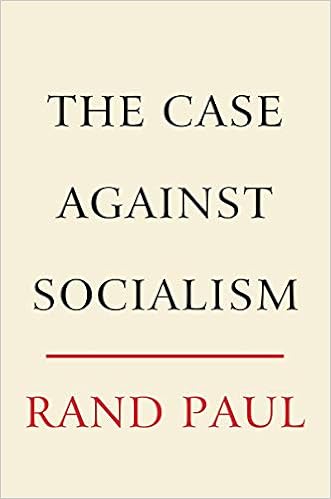
The Case against Socialism - Rand Paul

George Floyd is a household name. Nearly twelve months ago he died on the streets of Minneapolis uttering the words 'I can't breathe', now indelibly etched in our collective conscientiousness, as a policeman's knee was on his neck. 
Shortly after this event, in the wake of the riots around the world, I spoke to a perplexed colleague about this issue. He was endorsing the riots, the outrage, and racism involved in this incident. Feeling quite diffident and mildly rebarbative I challenged many of his key assumptions, particularly in regards to what he wanted done. Derek Chavin, the policeman being held ultimately responsible, had been sacked, arrested and incarcerated - politicians and the public alike had decried what had happened. 
'What more do you want?' I declared. 
His answer was that fairness, equality and equity needed enforcement - and socialism - because it is the ideology of what is fair, equal and equitable - must be impelled. 

Anti-racism is, in essence, Socialism. Just read Kendi's book; racism is not colour related as black or coloured people can adopt 'whiteness'. Kendi specifically says that feminism, inequality in all forms: environmental, reproductive, gender, sexuality, economic, religious, colonial, and those that are differently-abled, are the very definition of racism and to reject these - in all of it's guises - is being an anti-racist. Ostensibly, to be an anti-racist, one needs to reject whiteness in all of its social, intellectual and moral manifestations and implications. To tear down society because it is white, and build the Socialist utopia. 

Socialism is becoming popular again; and I have my views pretty well sorted out on this subject. Then why read Rand Paul?

Rand Paul is a libertarian - I am not. Neither of us likes Socialism and I am wondering if we reason the same way about this. Some conservative pundits are fond of saying that '...I am Libertarian about this...', therefore, I am intrigued to see if there are inherently conservative arguments against socialism and libertarian arguments that are distinct. So - this explains why I am here.

To explain why I decry libertarianism and laissez-faire capitalism will take us too far afield, but I reject the Objectivism of Ayn Rand and the greed, narcissism and misanthropy germane to her views. 

When I first picked up this book I was expecting an analysis of the issue - I expected to sketch some history of Marx & Engels, economic disputes and the Bolshevik Revolution. To my surprise he started in Caracas with Nicolas Maduro. This didn't bode well, as while a case can be made from the litany of failed Socialist states, and the invariably descent into collectivism and authoritarianism, I am unsure this is the best way - I think that I may be wrong as the reading became more interesting as the modern expressions of Socialist ideology unfold.  Of particular interest was the preparation for the Chavez/Maduro iteration of Socialist dominance. It was not the 'Castro-loving Hugo Chavez' that transformed Venezuela - rather a long march to the scaffold starting in the late 1950's with Romulo Betancourt through to Carlos Andres Perez. When Chavez came on the scene in 1992 in the failed coup, imprisoned, then elected president in 1998, Venezuela's Socialism was ratcheted up significantly - to the rancorous applause of the American left, Bernie Sanders and Noam Chomsky et al.

Paul rather pugnaciously entitles this section 'Because eating your pets is overrated - Socialism creates poverty'. Cantankerous as Paul is - he is not wrong.

So, Paul starts his indictment of Socialism with the idea that there is no Socialist Utopia in existence - nor has their every been. Paul has convinced me that this is the place to start - not a refutation of Marxism. Show me a successful Socialist state - they all indubitably end up in poverty, plutocracy and violence. The answer to this charge was always that this was never real Socialism - however, that is not the rejoinder anymore; rather it is the index finger pointing, with alacrity, towards Scandinavia. It is to this issue that Paul turns next.

Then the trump card is played by the Democratic Socialist - it is the Scandinavian countries that are the Socialist success stories! That is what we want! Denmark, Sweden, Finland and Norway. They are the socialist successes.

Paul demolishes this nonsense, quoting the Scandinavians themselves - demonstrating that they have a Free Market economy and quoting Scandinavian officials denying the charge. Simply put, Scandinavian success is build on Capitalist success

"If government ownership of the means of production is the sine qua non of socialism, the facts argue quite convincingly that the Scandinavian economies simply are not socialist." p. 80

 Then, Paul focuses on the issue of income inequality, the issue of the modern socialists like Bernie Sanders and Alexandra Ocasio-Cortez. Quoting Dalibor Rohec, Paul begins his common sense attack on this pivotal issue:


"If one cares about the welfare of the poorest and most vulnerable Measures of inequality tell us nothing about the living conditions of the poor, their health and their access to economic opportunity." p.53

This is, of course, true because economic inequality may be very small - and everyone be poor. Pakistan, Ethiopia or Venezuela all have better income inequality rates than the US - or here, for that matter - but that is because they are all equally poor. These are well worn arguments - to which there is little comeback from today's elite. Nothing more than invidious moralising and Ad hominem. 

Paul is scandalised, and rightly so, by this inane answer. He deftly cites the Socialist experiment of Pol Pot's Khmer Rouge in Cambodia. Paul leads us through a history lesson of Pol Pot's education in France and his obsession with Marx & Engel's famous manifesto. He notes how the Cambodian revolution under Pot was the most pure example of Socialist ideology.

"He [Pot] achieved, more than his predecessors, the true goal of abolishing all private property and he didn't seem to mind if it took more than a few broken skulls." p.197


Paul moves from this to an analysis of Hitler's socialist underpinnings - starting with the name of the party and then demonstrating the policies of the regime. Following this is some trenchant inquiry into Maoism, Stalinism and the Khmer rouge. More devastating links to the inevitable authoritarianism that follows socialism.

He looks at the 'Green New Deal' of the American left and ends opining on the virtues of Capitalism and that 'free markets make free people'. My hope is with him in that I desire people choose liberty too. It is a very libertarian ending - but it has great moral force.

Wedged between these last two sections is the most fascinating bit of the book - and the part in which I am still thinking through. Part IV is entitled 'Where are these angels? The philosophy of Socialism. I needed to read carefully here - and indeed this section is the part of the book that is harder to follow - one needs some familiarity with the philosophical ideas to follow the thought process.  Also, not being a Libertarian, particularly an Ayn Rand Objectivist, I needed to weigh my thoughts carefully.

Paul argues from Plato's brand of state governance, past Thomas More's Utopia through to Hegelian dialectic that is so intertwined in Utopianism of all stripes. Here is a scathing denouncement of Historical determinism. It is hard to disagree with Paul here - it is an interesting take. Using Karl Popper to undermine the case of determinism and the connection to utopianism, Paul makes his case stronger. However, he then mounts are argument that is close to my heart - we'll call it the argument from Dostoyevsky; for want of a better term. Using the masterful Notes from Underground, Paul launches an attack on the magisterial use of reason to justify Utopianism. 

Paul is correct that utopianism is the point of the philosophical conflict behind these different political visions, and in a unexpected twist, he unravels Fukuyama - and other Neoconservatives for sharing the Hegelian historical determinism in defense of a Liberal democracy. He ends with these sage words:

"From my perspective, the cautionary moral of a utopia is: don't succumb to any end-of-history utopias from the right or the left. Don't accept any preordained linearity to history." p. 243

There is no doubt that this philosophical section is the apogee of the book. However, the denouement should be stated again. Namely that 'Freedom should bring us together. 

I remain decidedly not a libertarian, I do not agree with Paul on any number of his policies that reflect this libertarian bent. However, I am in lock-step with this withering critique of the detritus of socialism. It is true - Freedom should bring us together. And perhaps that is the angle that one should take in the light of these repressive Covid19 lockdowns. The constant intoning of the safety of the Collective, can only be undone with a rallying cry of Freedom.

Addendum:

This is politics and 'Politics ruins everything'. As a Christian, freedom is most certainly the answer. Moreover, Freedom - rightly understood - is freedom in Christ. I have no doubt that terrible times are coming and they are known by God. His providence is at work nonetheless - and freedom in Him ensures that we need not fear the trouble that is to come. Politics will never bring peace. Peace comes in the sky with the Prince of Peace. This is NOT historical determinism - rather, this is the plan of an omniscient God.

1598 Words

4 1/2 Stars

Sunday, 24 January 2021

Right Here Right Now - Stephen J. Harper


I wasn't aware of this book - simply not advertised in Australia; however, I heard an online interview with Stephen Harper and was absolutely riveted by his intelligence, thoughtfulness and insights into political conservatism.  He governed Canada as Prime Minister for nearly a decade, through the financial crisis of the late 2000's and being a member of a G7 nation - sat at the tables of power for some time.  This man was in the room.

The book starts off discussing Trump, really not a book about Trump at all.  It is a book about Populism - the dirty word in current politics.  It was populism that brought in Brexit, populism that swept Pauline Hanson into a influential upper house position.  Populism that championed Trump and - allegedly what Macron is currently empowering in France.  


What is populism?  Well, to the ideological left it is all that is wrong with politics; indeed 'Populism' has become a loaded word.  Harper opines that populism "...has been made the default explanation for any political view or event that diverges from the establishment opinion.  Opposition to trade deals? Populism.  Protest against immigration? It must be the populists.  An unexpected election result? What else but populism?" (p.13). Harper astutely recognises that contemporary liberals have a penchant for calling ‘political outcomes’ that the like, democracy; and those that they do not, populism.  In other words, they seek to equate populism with demagoguery (p. 13).  Harper is thoughtful about the opposite of Populism - it is political elitism.  Harper argues that this is an example of demagoguery itself as populism is from either side of the spectrum and can have positive effects as a tool to reorient interests of the common people ahead of the interests of the privileged few.  Harper then reminisces about the history of populist parties, ranging from his own experience in 'Reform Canada' through the populism of the USA, from pre-WW1 farmers - through to the influences of populism in Teddy Roosevelt - to the political metaphors in the Wizard of Oz.  Here Harper identifies four themes in Trump's inauguration speech that gave voice to dislocated non-college educated workers:


  • Economic realism - Trump espoused the virtues of bringing Industry back to the US.
  • Trade - he identified trade inequities, like the US relations with China and Mexico.
Neither of these things are particularly conservative - one expects conservatives to explain the morality of Markets and espouse Free Trade practices.
  • Nationalism - Trump unapologetically pledged to put America First.
  • Immigration - He spoke of 'protecting borders' and crafting immigration policy in the National interest.
These latter two points are interesting as 'Nationalism' or the tribal sort is much closer to the extreme right and is a dubious foundation for a Burkian Conservative position. Harper's thinking around these issues are interesting and his recollections about the implementation around these issues are gripping. 

However, this is not a book of reminiscing, like many political books of this ilk, rather this is a manifesto on Harper's Canadian conservatism. Where he seeks to defend populism and Nationalism as ideas and pragmatic tools.

It is a shame that this has not been more widely read in the aftermath of the Trump 2020 election defeat. It certainly provides a robust and trenchant defense of conservatism - a much needed one in the light of a Trudeauian Canada and a Bidenesque USA.  Boris looks set for defeat in light of his double-minded lack of leadership in the UK and Morrison may well be rocky too in Australia.

We will see.

This is a must read, for it's chapters on Populism and Nationalism alone.
5 Stars.


Thursday, 17 January 2019

Force of Nature - Jane Harper

A month ago my Mum thrust Jane Harper's debut novel -The Dry - in my face and said that I should read this.  My Mum and I have a penchant for Murder mystery type books.  I think that it is the British Agatha Christie streak that runs through us - but we enjoy a good murder mystery.  This is a little bit more of a thriller (as most crime novels are nowadays), but it was as Australian as Bush Tucker and fairly well written.  Well, as good a read as "The Dry" was, I think this one has it beaten.

It could be that I bounced back from reading the loathsome new Jack Reacher novel.  Lee Childs is an awful writer and his formulaic, predictable tripe leaves one desiring something enjoyable.  Jack Reacher: Past Tense, was a book of short sentences (if you stretch the definition of sentences to a handful of words, always starting with a preposition, put together in an arbitrary manner) and little substance.  Graphic descriptions of the violence and incoherent plot issues are the most enjoyable aspects of the book.  I was on holidays - and it was there.

Force of Nature is much more thoughtful.  Aaron Falk is a Federal Policeman in the financial division of the fraud squad.  The first book dealt with his hometown and the murder of his childhood friend.  It was the Australian drought through and through.  Harper deals with some more nuanced family issues this time - and there are some lovely little dialogues between his partner Carmen Cooper and Falk.  She pushes him into interesting admissions and acknowledgments & I appreciate how she acts as the method to unveil some of Falk's struggles; rather than spicing it up with a love interest.  The tender kiss followed by "I am still getting married" and the climax of the book is refreshingly real and understated.  I love the way that there is no sex or violence in this work, rather some lovely writing explicating the terror of the Australian Bush and the dank fug of Australian Rainforests.

As the story unfolds there are some interesting character development amongst the girl on the hike.  The delicate mocking of the corporate world with smarmy job titles like the 'Strategic head of forward planning' and obsequious characters who hold their servile responsibilities in the middle of the Bush, reminds one of the periphrasis of Dickins's "Office of Circumlocution" in Bleak house.

The story is about five women who enter the bush on a corporate team building exercise and four re-emerge a few days later.  Alice goes missing, which drags Falk into the story as Alice is a whistle-blower against money laundering within her company.  There is one really thoughtful passage that deals with Free will / determinism and a reflection of their lives and the role choices play.  It is well weaved into to some interesting discussions amongst the lost girls.

I love the character focus in this book, it makes the crime/suspense aspect all the more riveting.  Falk didn't play as much of a role as in the last book - however, I do not think that the book suffered from that.

Jane Harper is a great writer - however, it did become a little clumsy at the end.  The short chapters didn't speed up the tempo of the denouement, and the clichés started to emerge.  All in all 4 out of 5 stars.  Even though it hasn't won the accolades that her first book did, I think that it is better.

Sunday, 13 January 2019

Teacher - Gabbie Stroud

After working sixteen years in my current school - intended to stay no more than five years - I attended my first English meeting.  In 2019 I am teaching Year 8 English, my first time teaching English, ever!  In this meeting, the Head of English handed out raffle tickets and at the end of the meeting, she selected tickets and gave books for prizes.  I won this book.

Two or three teachers came up to me extolling the value of this read - so I took it away on holiday to give it a going over.

Any teacher will resonate with this book - the frustrations of modern teaching are well described in a real Australian yarn.  Gabbie shares her story; and it is a sad one.  It chronicles her journey through teaching to leaving the profession.  She touches on issues of hiding behind educational jargon, having children with disabilities in the classroom, behaviour management, NAPLAN and test standardisation, performance pay, the nature of schools as a business and workload stress.  These are matters confronting all teachers across the world.  However, this remains a pragmatic book and chronicles the impact that politics and educational philosophy are having on the workplace.  It is hard not to be compassionate about her struggles and angry at the structures of schools, yet this is a superficial look at the problems we are entering into in modern education.  It seeks to value the teaching profession and teachers individually - however, it can over-eggs the pudding.  It is much better as a memoir than putting any cogent critique of Education.  More Michelle Obama's "Becoming" than Neil Postman's "The End of Education".

As an insight into an invested teacher's life, it is touching, and well written.  She weaves her narrative, her family breakdown and her difficulty surviving in the current Australian Education system in a delightful way.

However, I get a little suspicious when teacher's sentimentalise our profession.  Gabbie leans this way at times.  I must confess that, as teacher's, we have a penchant to believe our own press.  I can think of no better way to describe this phenomenon than Taylor Mali, the Slam poet.  He has a piece of performance poetry called "What Teacher's make".  We all want to believe that we make a difference, that our role in life is important - yet, of all the professions that I have worked in - teacher's alone cling to their own hype.  I like to think that I make a difference in people's lives - there are past students that I have kept in contact with, and who make me proud; I'm glad that our lives intersected and am truly honoured to have been of assistance to them.  But I cannot countenance that I was the profound influence that Teacher's like to think that they are.  We believe our own ballyhoo; even though it is propaganda.

Postman's magisterial book on the nature of Education divides schooling into two sections, the metaphysical and the mechanical.  He states that we spend too much time on curriculum, bells, timetables, processes and policies - all this is valuable, but there is a '...crisis of narrative...' going on in our schooling.  It is this metaphysical issue - the 'gods' of education - as Postman puts it, where we need to seek first.  Here, Stroud is at sea - she has a strong desire to impact children positively and a real heart for kids and a passion for learning, but no real insight other than her own experience of being disheartened.

It is sad that such a competent teacher as Stroud has left our ranks.  It should be an affront to policy makers and school management that such passionate teachers leave our profession.  I love her writing - I feel her pain, but I think that when a book like this moves beyond memoir and seeks to say something meaningful about Education, we need to rue the demand to be empathetic! We need some rigorous thinking behind us.  We also need to be wary of believing our own press.  We are not as much of an influence as we think.  We need an Untouchables - Eliot Ness type of embarrassment to eschew this nonsense.

I get the feeling, re-reading this, that I am not really fair in this review.  Maybe what I am expecting from this book is simply not what it is meant for.  This could very well be an over-preoccupied teacher, misreading this book in light of my own thoughts.

Teaching is changing at breakneck speed in vapid directions.  Social-constructionism, flipped learning, teacher as facilitator, skills-based learning, inquiry models, 21st Century learning skills, mindfulness and Learning Styles are swamping Educational facilities with little empirical evidence backing them up  or pragmatic awareness of the negative impact they have.  This is ideologically driven stuff.  Unfortunately, very few Staff are philosophically incisive in thought or are perspicuous in expression. Particularly at the management level. 

Look, I suppose I recommend it - I gave it to my Mum to read and I giggled, hurt and shook my head in resonating with her tale.  

3 out of 5

Thursday, 31 March 2016

The Last Hundred Days - Patrick McGuiness


I remember meeting a musician who I worked with some years ago.  We have now lost contact, however, he was an extraordinary musician – not valued anywhere near enough in this country.  He was originally a Romanian, now a naturalised Australian.  That’s all well and good; but, one day when we were teaching together – a group of us started talking about authoritarian governments and the worth of studying Yr. 12 History ‘Revolutions’.  Not knowing much about Romania – Petré (named changed) opened up about his experiences living in Romania during the reign of the Ceausescu’s.  He talked about having unstable electricity, ½ hour of TV on Friday afternoons that are Party propaganda; he talked about never being able to share political views – even with one's closest friends.  You simply never would – you never know who will inform the Secutariate of treachery.  Further, he talked about how in 1989, the shooting of Nicolai & Elena Ceauşescu was sprayed, repeatedly on the TV for all to see.  It is now easily available on YouTube – the trial and killing by firing squad.  He was happy that they were gone – but he left Romania, in search of a better life and to leave the Socialist propaganda.

A few years later I read that amazing book, ‘Tortured for Christ’ by Richard Wurmbrand.  This Romanian hero was important for blowing the lid off of Romanian Christian persecution.  The stories he told are unbelievable barbarity, mixed with astonishing strength of faith and courage.  Then a trip to the Romanian Baptist Church in the outer Eastern suburbs of Melbourne furnished me with real stories of faith and suffering.

Then with the mention of Patrick McGuinness’s book the ‘Last Hundred Days’ against the background of the Romainian revolution in 1989 – my interest was piqued.  The book was long-listed for the Man Booker Prize in 2011, that didn’t bode well – but I steamed ahead anyway.
McGuiness is an academic, this worried me as the list of academics who are great writers, one can count on a single hand.  This is his first book and he can write extraordinarily well; yet it is his familiarity with the milieu that really piques one's interest, the great writing is the paint that describes the city of Bucharest during the last days of Ceauşescu's reign.

"In the cemeteries the graves were marked out with wooden planks, table legs, chairs, even broomsticks.  Ceauşescu's new palace of the People could be measured not just in square metres but in gravestones." p.33
 The city of Bucharest is really the central character in the story.  The grey drabness of the city and the wistful memories of what Bucharest; coupled with the desire to document the remaining areas of uniqueness by Leo - puts the city as, not only the backdrop, but in some ways the hidden protagonist.

The main person in the story is an unnamed Westerner who comes to take an undeserved position at the Bucharest University.  There he meets Leo, another professor - he has some romantic relationships, even gets removed from the country - all while facing the corruption and brutality of the Socialist ideal in Romania.

But this is in the advent to the fall of the dictator:


"With Leo around, daily life was felt less as Stalinist terror than as shady ineptocracy - brutish and clumsy, sometimes comical, usually absurd.  Our sense of the system's viciousness was offset by our belief that it was not sufficiently organised to implement that viciousness." Chapt. 7


The climax of the book revolves around the public killing of Nicolai & Elena, and his last speech in public from his Palace.  Both of these events were broadcast on TV.  Indeed my friend told me that the firing squad shooting the couple was played over and over again for nearly a week on TV.  Well these things are now available on YouTube.  I watched the shooting and the speech and the book puts this all in context.  All written by an man who was there.  This really is the height of Historical fiction.

Extrodinary writing, riveting plot, historical accuracy and pathos.  This has it all. 4/5 Stars

Friday, 13 November 2015

Post God Nation - Roy Williams

This book has a fascinating premise, and if it was found to be substantial, this would be quite some find.  Roy Williams is an Australian former-lawyer turned Australian apologist for evangelical Christians.  His first book was 'God Actually' and was an interesting read.  Most of the Dawkins rebuttals were streaming from the US, very few Australians were engaged, John Dickson and Greg Clarke the possible exceptions.  Now Williams has come on the scene.  He is a lucid and clear writer that has a panache in some of his turns of phrase.  He his clearly Australian and that semi-diffident attitude comes across in his writing.  Should the mantle of evangelical leadership be conferred upon him?  Should he be the voice of evangelical reason and should he be widely read amongst the evangelical community?  Well, I'm not so sure about that!

This work dominated my September reading, and made me think long and hard about the premise behind the book.  It is divided into two parts - firstly, 150 pages called 'Our Religious Heritage' and was the part of the book that was most interesting.  However, the links that William's makes between Christian belief and Australian heritage range from quite convincing to unpalatably tenuous.  The reductive nature in which William's ideal of Christianity is presented is somewhat disturbing.  Henry Parkes is a perfect example - whilst admitting that Parkes had numerous dalliances outside of his marriage, William's credits his involvement in Federation and fatherhood and influence on the nation, to Christian ethics and virtues.  This is because his wife and daughter were committed Christians, who influenced him.  William's cites a letter from his daughter urging him to flee Hell-fire as an example.  Deist's like Captain Cook and others are presented as semi-Christian.  This reductionist forms of Christianity and broad strokes are clearly used to promote his thesis.  A more explicit example is this: 

"...Australia's finest ever legal mind, Owen Dixon was an agnostic.  Yet his grandfather had been a lay preacher with his own chapel, the Zion Independent Church of Lower Hawthorn, and his father-in law was an Anglican minister."  p.144
Tenuous indeed! However, there are many places where the thesis holds much firmer.

I was, however, particularly interested in William's treatment of the Myall Creek massacre of 1838.  William's is worth quoting here:

"There was nothing especially unusual about this gruesome event, other than the aftermath. It was a very rare occasion when a measure of justice was done. Seven of the murderers… were  tried and convicted. Subsequently they were hey. This happened even though majority popular opinion was on the side of the accused at large amounts of money were contributed today the fence-including a contribution by the wealthy owner of Myall Creek station, Henry Dagnar.  The culprits were punished in this case because of a near-unique combination circumstances and individuals. Several principled men Took a stand in the face of private intimidation and public opprobrium, including a white witness, hearts-keeper George Anderson, and two local stockman, William Hobbs and Frederick Foote, who reported what they had learned to the authorities.  Equally crucial was the fact that four key public officials were serious Christians: the police magistrate at Muswellbrook, Edward day; The attorney-General and prosecuting counsel, J.H. Plunkett; the presiding judge the second trial, William Westbrook Burton; and the Governor of New South Wales, Sir George Gipps." p.56-57

 However, despite some flimsy premises and reductionism of Christian belief, there seems to be a bigger issue with the book - that is the bizarre equivalence with Christian morality and the political ideological Left.  This is sparsely scattered through the first section of the book where William's will refer to great Protestant Socialists and Catholic Socialists. The second section of the book, entitled, 'The Secular Juggernaut' is very different in its approach.  In places it is a diatribe against Christians who hold politically conservative views. Perhaps, I should more closely define my criticism - the issue is more about Williams's conviction that real Christianity (which is ironic after spending the first half of the book being reductionist) is aligned with the social/moral ethic of the politically Left.  This is a real revelation to those of us who are becoming more politically conservative.  This is a real answer to the initial question that I had when I picked up both of Roy Williams's books:

Why did the ABC publish books from an evangelical?  Why did Left-wing Journalists like Gideon Haig and Annabel Crabb endorse these books?  Why, because Roy Williams is one of their children.  He is a voice to the pesky Conservative Christian community to dump political conservatism and be a real Christian in the camp of the Labor and the Greens.  He is their child and will reinforce their propaganda to the Christian community. 

The Christian community has been under assault from wolf-in-steeps-clothing like Tim Costello, Roland Croucher, Rob Buckingham (Melbourne) et al. for some years now.  Perhaps we should add the Presbyterian Roy Williams to this list?

Well, maybe, maybe not.  Williams has stated on the ABC website that he thinks that Christians should get over their fears of Homosexuality but doesn't think that gay marriage should be State endorsed. 

Williams is a socialist and unabashedly so.  He lauds Samuel Griffith as perhaps one of the greatest Australian (Williams's caveat is his indigenous record).  His Christianity is represented in the book by his statement:
"'The great problem of this age,' he said at the time, 'is not how to accumulate wealth, but how to secure its more equitable redistribution.'" p.143
This is a statement of Socialism, not Christianity.  Yet the lines are blurred between the two.  Williams clearly believes that Socialism is an offshoot of Christian ethics.  Williams launches a blistering attack on John Howard's Prime Ministership - accusing Christians of associating with the xenophobic popularist politics of the super-rich.  Catholics in the the Liberal party get a shellacking too - they care too much about divorce, homosexuality and abortion, and not enough about war, climate change, social justice and abortion (p. 147)  My reading of Williams seems to be that he believes that many Christians finding a political home on the Right have added to secularisation of this country.

Contrast this with the 'earnest' Catholics however are on the Left - Scullin, Chifley, Calwell and Keating.  Sigh, this is partisanism at its best and  this is best seen on p. 156.  Right-wing secularists only care about making money and an unregulated economy.  Maybe this is true of some, but in my experience, right-wing secularists care more about the intrusion of big government and excessive regulation.  The bleeding heart Leftist create the problem by insisting that drucken teenagers are a victim of money-hungry business owners and are not responsible for their actions.  Herein lies the issue.  Many who are wealthy are on the Left, and his argument is selective and fatuous.

Williams will not speak for many Christians for this misrepresentation of their beliefs.  I think that he is a genuine Christian, he is an intelligent and thoughtful one too.  I do not object to disagreeing with him on minor points - but the neo-Left is as concerning as the neo-Right and Christianity shouldn't be ascribed to one side of politics - the truth of Jesus is confronting wherever we go.  I tend to agree with the conservatives - the promotion of the family and of social good.  I am unconvinced with the big government, socialist policies of the Left.  I am circumspect with the Climate Change alarmism and the types of social justice that I see today that abrogates human responsibility, and the bullying of the pro-homosexual lobby to enforce the redefinition of my sexual ethics and the privatisation of my faith.  I care about war and disagree with the war-mongering of BOTH sides of politics - even more the humanitarian interventions so often cooed over by the Left.  

Williams has many good points too - however, I worry about this type of Leftist propaganda in Christian garb.  I think that he is a sincere man - however, he should be more circumspect about the reasons the ABC would publish a book like this from him.  I doubt whether they would publish a conservative author on the same topic.  Like Aaron Sorkin often does in his TV shows.  He sets up a Republican that he finds acceptable and then demonises the rest.  Williams does something similar to Christians.  This makes Christianity more palatable to the Lefty journalists - doesn't do much for Christianity or the cause of Christ.

3 out of 5 stars

Friday, 23 October 2015

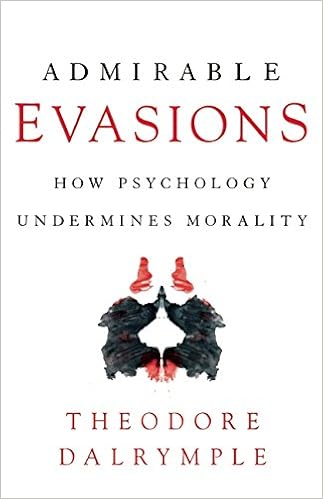
Admirable Evasions - Theodore Dalrymple

It has been some months now since I have blogged - not that I have stopped reading, although, that too has slowed with everything that is going on in life presently.  I am trying to set the reading record straight by a series of entries to catch me up.

It was a little bit of a thrill when I found that Dalrymple (Daniels) had published another book.  The man is nothing if not prolific.  I first came across him in 2005 when I read his book "Life at the Bottom", then the superlative "Our Culture: or what is left of it".  Finally, "Spoilt Rotten: The toxic cult of sentimentality", this is the seminal book on sentimentality and it's affect on Western Culture.    When you live holding a minority worldview, it is always exhilarating to read Dalrymple's work.  It washes you clean from the daily grind and refocuses you on thinking through issues rather than the sentimentalism of today's secular left.  Since then I have tried to follow his essays online.  There is a tremendously insightful essay on tattoos dated from the year 2000, it is even more prescient today than when written.

Daniels is a doctor, but has fostered a love of literature and philosophy since he was pressured into a medical career.  For many years he worked as a prison doctor, indeed a psychologist.  He is well travelled, well read, well though of and can he write!

Well, 'Admirable Evasions: How psychology undermines morality' is a fascinating book.  I jumped at the chance to read it and read it quickly.  I digested it in the week leading up to a seminar that I went on hosted by the 'Science of Learning' centre at Melbourne University.  This seminar was on Neuroscience, Cognitive Psychology and Education.  We currently have undergone a wholesale change in attitude at my workplace where 'Positive Psychology' and it's mystical corollary 'Mindfulness' have entered the sway and been uncritically and universally accepted as good things.  I have been somewhat skeptical about this change and have been glad that it has not directly affected me.  This is not being unduly critical of my workplace - this stuff has been accepted across Education nationwide.  This is the current fad!  Everyone is a part of it to greater or lesser extent.  Along with this, I was interested to read that the Neuroscientist present at the conference was a student of Stephen Pinker.  I assumed that he would be in Pinker's mould, an adamant Monist, physicalist and hostile to any form of dualism.  I signed up thinking that I may be an unwelcome agitator.

To my surprise, the opening salvo was a stern denouncement of the way Neuroscience has entered Education.  They openly mocked and decried the folly of the many programmes that are introduced into schools as the next best thing and how neuroscience adds credibility to Educative programmes that are not warranted.  Further, they stood by the statement that Neuroscience has nothing to offer Education.  The presenters were of the belief that Neuroscience can only inform Educators when filtered through the medium of cognitive psychology - a thesis in which they have since published, and one with which I concur.  Moreover, the Neuroscientist turned out to be a duelist and smiled when I looked at him astonished.  He said "Pinker is a lovely guy and has been so supportive of me, however, when he opens his mouth, I just can't bring myself to believe that stuff."  I was stunned.

Dalrymple's book prompted questions that I did't have to defend - they were largely agreed with.  His assault on Modern Psychology starts immediately:

"Psychology is not a key to self-understanding, but a cultural barrier to such understanding as we can achieve; but it is my belief that we shall never be able entirely to pluck out the heart of our mystery. Of this I am glad rather than sorry."

His distain for the effect upon society is clear:
"We owe incomparably more to improved sewers than to psychology."
He is invariably in tune with the Utopian nature of the influence of Neurology and psychology in our modern world and compares it with the enlightenment view of Liberal Democracy.

"Before long, if there is sufficient research funding, there will be no more puzzles and no unpleasant surprises, no agonizing dilemmas in human existence; the question of the good life will have been settled once and for all, indubitably and scientifically, without the necessity of endless and unprovable metaphysical speculations ... History will come to an end, this time not by virtue of the triumph of liberal democracy throughout the world, but by that of the triumph of psychology and neuroscience. Man will no longer pass on misery to Man, as in Larkin’s poem; he will pass on knowledge instead, knowledge and wisdom being of course by that stage coterminous. Indeed, knowledge will secrete wisdom as the liver secretes bile."
Dalrymple really resonates with me here - his declaration at this point is, "I don’t believe it, and I’m not sure that I would want to live in such a world if it were true." I wholeheartedly agree!

Dalrymple then proceeds to systematically undo Freud, Psychoanalysts, Behaviourism and the ultra-modern penchant for Neurology.
"That the latest neuroscience as a means of humanity understanding itself has been grossly oversold scarcely needs proof. It offers the illusion of understanding rather than understanding itself."
Self-understanding is best found in literature, Dalrymple argues - he says that psychology has not advanced human understanding beyond Shakespeare (the title of the book is taken from King Lear).

"...psychology has contributed nothing to human self-understanding; rather the reverse: for by coming between a man and what Doctor Johnson called “the motions of his own mind,” it acts as an obstacle to genuine (though often painful) self-examination."

As usual, Dalrymple is right.  However, our society will not heed the call, but plough on its shallow way of carving out the coming dystopia - where the search for Utopia always ends up.

5 Stars - I'd give it six if I could.  Must read.